Introduction: Why Choosing the Right RFP Software Matters
Request for Proposal (RFP) management has evolved from a time-consuming manual process into a strategic function that directly impacts sales growth and efficiency. For financial, procurement, and professional service teams, the right RFP software is not just a digital tool but it is an engine for productivity, accuracy, and collaboration.
As RFPs become longer and more complex, managing them through email threads or spreadsheets drains resources. The best RFP software helps businesses streamline workflows, automate repetitive tasks, and standardize proposal quality, allowing your team to focus on strategy and relationship-building instead of administrative chaos.
What Is RFP Software?
RFP software is a specialized proposal management system built to simplify how businesses create, track, and respond to Requests for Proposals. It provides a centralized platform for tasks like document and records management, assigning tasks, and tracking progress, all within one organized workspace.
The best RFP software goes beyond simple document handling. It incorporates automation that fills repetitive fields, intelligent search features that locate previous responses in seconds, and analytics tools that measure performance. By unifying content and collaboration under one roof, RFP software allows proposal, sales, and procurement teams to work seamlessly across departments, ensuring every submission is professional, consistent, and competitive.
Why Businesses Need RFP Software
Modern enterprises cannot afford inefficiencies. RFPs often drive a large share of revenue, and a single missed opportunity can mean millions in lost deals.
Here’s why organizations are increasingly investing in RFP management software:
1. Efficiency and Time Savings
Automation eliminates manual copying and formatting. Teams can create first drafts in minutes rather than hours, freeing experts to focus on strategic input.
2. Centralized Knowledge
All proposal content, templates, and previous responses live in one searchable workspace; no more chasing answers across emails and spreadsheets.
3. Seamless Collaboration
RFP platforms enable teams to collaborate seamlessly across departments and time zones, tagging subject-matter experts and tracking tasks in real time.
4. Error Reduction
Built-in validation and approval workflows minimize compliance risks, ensuring every proposal is accurate and consistent with brand and legal standards.
5. Data-Driven Insights
Top RFP tools provide analytics dashboards that track win rates, response time, and content usage that help teams make informed decisions and continually improve.
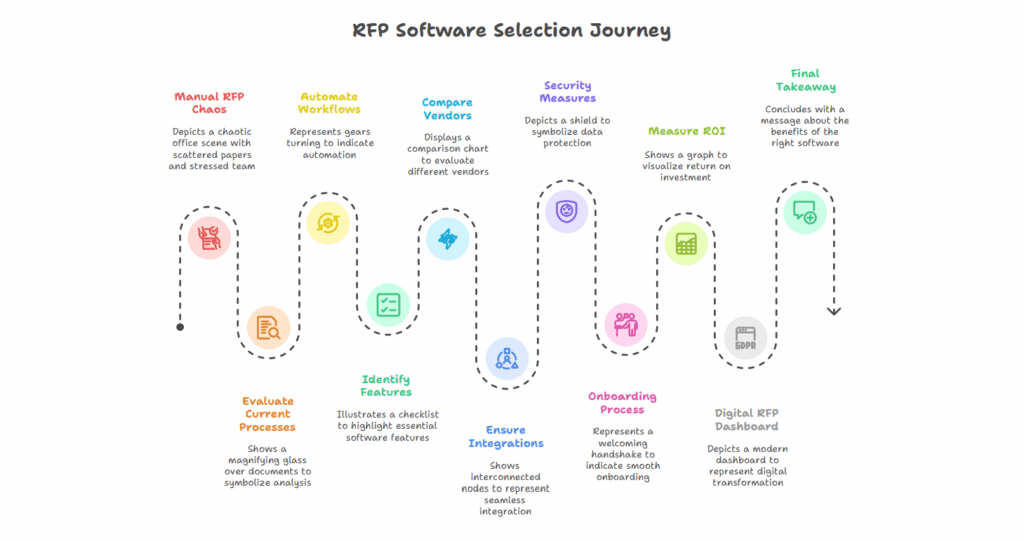
Step 1: Evaluate Your Current RFP Process
Before investing in any tool, assess your existing RFP workflow. Identify what slows you down such as disorganized content, inconsistent formatting, or unresponsive SMEs.
Ask yourself:
- Do we have version control issues?
- Are SMEs spending too much time on repetitive questions?
- Can we track project timelines and approvals efficiently?
- Is our proposal quality consistent across departments?
By identifying bottlenecks early, you can define specific needs that your RFP software must address.
Step 2: Determine Whether You Need RFP Automation
If your team handles multiple RFPs per month or juggles large response volumes, automation is no longer optional but it is essential.
Automating repetitive workflows such as answer matching, template creation, and document management helps keep the RFP process consistent and scalable.
RFP automation software can:
- Auto-suggest answers using AI-powered search
- Auto-detect outdated content and flag it for review
- Streamline task assignments and approvals
Automation ensures your proposal management process runs smoothly even as your workload grows.
Step 3: Identify Key Features of the Best RFP Software
When evaluating software options, focus on the core functionalities that make a tangible difference to your team.
Content Library and Knowledge Management
A customizable content library is the heart of every RFP platform. Look for tagging, categorization, and review workflows that keep information accurate and current.
Intelligent Automation
Leading RFP solutions leverage AI-powered automation and Natural Language Processing (NLP) to match questions with the best responses and suggest content improvements automatically.
Collaboration and Workflow Management
A strong workflow management feature lets teams assign tasks, set due dates, and manage approvals; these all within one workspace.
Integrations and Compatibility
Ensure your chosen solution integrates with existing CRM tools as part of your broader information technology services strategy for unified collaboration.
Security and Compliance
RFPs involve sensitive client data. So ensure the software has strong network security and support services, meeting SOC 2 Type II or equivalent security certifications, with encryption and role-based access.
Analytics and Reporting
The best platforms offer insightful analytics to track project progress, content utilization, and response quality that empower teams to make informed decisions and optimize processes.
Step 4: Compare Vendors and Shortlist Options
Once you have outlined your must-have features, start building a shortlist of vendors. Compare options like:
- Loopio – Known for intuitive libraries and collaborative workspaces
- Responsive (formerly RFPIO) – Offers generative AI, deep integrations, and strong analytics
- PandaDoc – Great for smaller teams managing proposals and contracts
- Procol – Strong for procurement and sourcing automation within enterprises
When comparing different RFP software, evaluate:
- Ease of use and onboarding experience
- Integration with existing tools
- Pricing transparency and flexibility
- Customer support responsiveness
Request demos and trials to make an informed choice that aligns with your workflow.
Step 5: Assess User Experience and Ease of Use
Even the best RFP management software is only effective if your team adopts it. During trials, evaluate how intuitive the system feels.
Ask:
- Can new users onboard quickly?
- Is the navigation intuitive?
- Does it simplify collaboration between proposal and sales teams?
A user-friendly interface with a smooth learning curve ensures adoption across departments and prevents the software from becoming shelfware.
Step 6: Evaluate Customization, Scalability, and Flexibility
No two organizations have the same proposal process. The right RFP software should let you customize templates, tailor approval workflows, and adapt to evolving business needs.
A scalable platform grows with your enterprise that supports new users, integrations, and complex multi-department workflows without performance issues.
Step 7: Prioritize Integration Capabilities
Your RFP software should integrate with your CRM and other existing tools to ensure a seamless workflow. Integration with platforms like Salesforce, HubSpot, or SharePoint allows automatic data exchange between sales and proposal teams.
Well-integrated systems reduce manual processes and create a unified workspace where teams collaborate seamlessly.
Step 8: Consider Security, Data Privacy, and Risk Management
Security is a major selection factor; especially for finance, healthcare, and government sectors. Ask potential vendors:
- What encryption protocols are used for data in transit and at rest?
- Are they compliant with GDPR or HIPAA (if applicable)?
- Do they offer access control and audit trails?
The best RFP software pairs security with transparency which gives administrators full visibility over who accessed what and when. Proper risk management, often covered by insurance-related services, should also be a key consideration.
Step 9: Evaluate Vendor Support, Training, and Onboarding
Choosing software is only half the journey but successful onboarding determines long-term ROI. The best vendors provide:
- Dedicated onboarding specialists
- Self-service knowledge bases
- Regular webinars and customer success programs
Smooth onboarding ensures your team starts using the platform efficiently within weeks, not months.
Step 10: Use a Data-Driven Framework to Select the Right RFP Software
Quantify the ROI of your decision. Calculate potential time savings, improved win rates, and reduced manual workload.
Key evaluation metrics might include:
- Average RFP completion time before vs. after automation
- Number of RFPs completed per month
- Win rate percentage increase
- Time saved by SMEs and proposal managers
These data points will justify your investment and help you choose the right RFP management solution for your organization.
Bonus Section: Common Mistakes to Avoid When Selecting RFP Software
Many organizations stumble during the software selection process because they overlook key factors. One of the biggest mistakes is failing to involve end users in the decision-making process; after all, they will use the tool daily. Others choose a platform based solely on price, only to realize later that it lacks critical automation or collaboration features.
Ignoring integration compatibility can also create silos and duplication, defeating the purpose of automation. Finally, skipping proper onboarding or training often leads to low adoption rates and wasted investment. Avoiding these pitfalls helps ensure your chosen solution delivers maximum efficiency and long-term results.
How the Right RFP Software Transforms Your Business
Implementing the right RFP software transforms your business operations from reactive to proactive. It creates a structured environment where information flows smoothly, deadlines are met, and collaboration happens effortlessly. AI-powered features and automation minimize repetitive work, while analytics offer visibility into performance and growth opportunities, which is a key part of any marketing and advertising strategy.
By centralizing the entire RFP process, you empower teams to respond faster, produce higher-quality proposals, and achieve measurable efficiency gains. In the long term, adopting RFP management software becomes not just a productivity boost but a strategic advantage in winning and retaining business.
FAQ’s about RFP Software
What is RFP software used for?
RFP software automates and organizes the proposal process; helping teams create, manage, and submit RFP responses faster and more accurately.
How does RFP automation improve efficiency?
Automation eliminates repetitive tasks, such as copying past answers or formatting documents, allowing teams to focus on strategy and quality.
Can RFP software integrate with my CRM and project management tools?
Yes. Leading solutions integrate with CRM platforms like Salesforce and project tools like Jira or Asana, ensuring a connected and efficient workflow.
Is RFP software suitable for small businesses?
Absolutely. While enterprise platforms offer advanced AI features, many vendors provide lightweight, cost-effective versions tailored for SMBs.
How do I know which RFP software is right for me?
Assess your specific needs, test demos, and choose software that balances automation, collaboration, and scalability without overcomplicating your process.
Conclusion: Make the Right RFP Software Choice for Long-Term Success
Selecting the right RFP software is more than a technical upgrade; it is a strategic decision that shapes how efficiently your organization competes, collaborates, and grows. The right solution not only streamlines the RFP process but also transforms the way teams share knowledge and measure performance, often requiring professional writing services to create compelling proposal content.
When RFP management becomes automated and data-driven, every proposal becomes an opportunity to showcase precision, professionalism, and speed. Whether you are a small business seeking efficiency or an enterprise managing hundreds of proposals a year, investing in the best RFP software ensures you stay ahead of deadlines and your competition.
Ultimately, the right platform aligns your people, processes, and technology; turning a complex proposal workflow into a unified, intelligent, and results-driven system. Take the time to evaluate, compare, and choose wisely. The RFP software you implement today will define how your organization wins tomorrow. To explore a comprehensive database of bids and discover how RFPPlanet can connect you with valuable opportunities in your industry, get in touch with our experts today.