A request for proposal (RFP) is one of the most valuable tools in procurement and project management. Whether you are sourcing a marketing agency, software vendor, or construction partner, an effective RFP sample helps structure your project requirements, timeline, and evaluation criteria. But simply downloading a free RFP template is not enough, it must be customized to your specific project needs.
In this guide, we will explore how to personalize an RFP sample to ensure it aligns with your objectives, streamlines vendor selection, and increases your chances of receiving qualified, competitive bids.
What is an RFP and Why Customization Matters
An RFP (Request for Proposal) is a structured document used to solicit bids from vendors for a project or service. It defines your scope of work, timeline, evaluation process, and submission format.
However, every project is unique and using a generic RFP template without customization can lead to vague responses, vendor confusion, and misaligned expectations. A well-tailored RFP sample:
- Clarifies your project objectives and desired outcomes.
- Helps you compare proposals using consistent evaluation criteria.
- Encourages vendors to submit targeted, relevant responses that meet your needs.
As Vendorful and Responsive highlight, good RFPs are concise, transparent, and tailored to your business problem rather than copied from templates.
Understanding the Purpose of an RFP Sample
An RFP sample is more than a formatted document, it is a communication framework. Its purpose is to define your problem, present the desired outcome, and help potential vendors understand exactly how to respond. It allows you to assess each proposal consistently and choose the best partner based on facts, not assumptions.
According to experts at RFPVerse, an RFP functions as a bridge between your business objectives and the vendor’s capabilities. It ensures clarity on requirements, expectations, and deliverables so that all proposals you receive are comparable and aligned with your procurement goals.
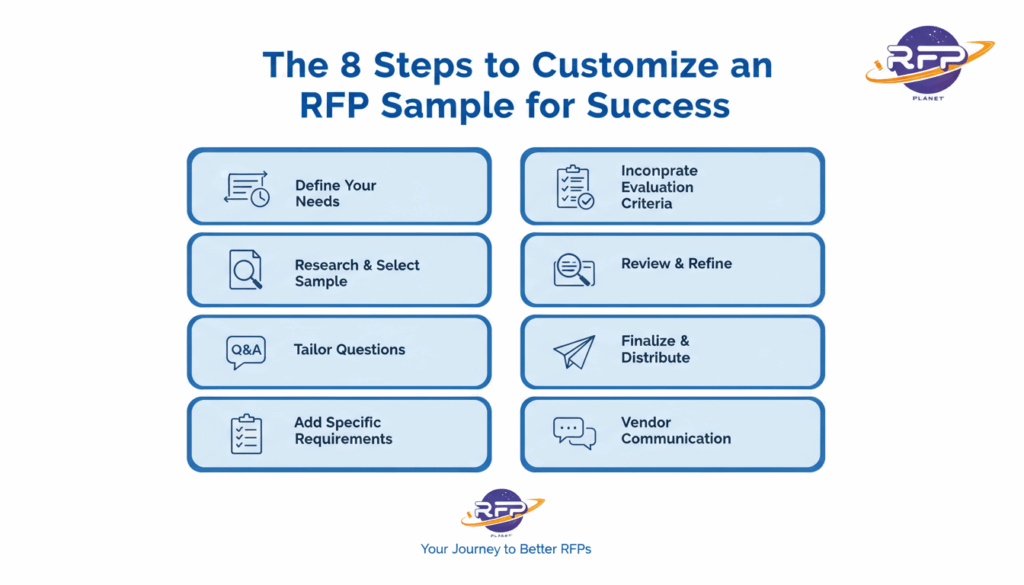
How to Choose the Right RFP Template
There are thousands of RFP templates available online from simple one-page formats to industry-specific samples. When selecting one:
- Match the template to your project type.
For instance, IT services need technical sections (security, integration, data handling), while creative projects require brand and design briefs. - Evaluate the structure. It should include key sections like background, goals, scope, timeline, evaluation criteria, and submission requirements.
- Ensure it’s editable. A flexible format (Word, Google Doc, or RFP software) allows seamless collaboration and version tracking.
Start with a free RFP template from a credible source, then use the steps below to customize it for your specific project needs.
Step 1: Define Your Project Scope Clearly
Every strong proposal begins with a clear scope of work. Your RFP sample should outline:
- Project background: Why the project exists and what challenges it addresses.
- Objectives: What success looks like (e.g., “increase website leads by 30%”).
- Deliverables: Specific outputs you expect (reports, designs, code, etc.).
- Timeline: Start and end dates, milestones, and deadlines.
Clarity helps vendors understand what they are bidding for and ensures that responses are accurate and aligned with your expectations.
Step 2: Customize the Evaluation Criteria
Your evaluation criteria determine how you will score proposals. Most RFP templates include general factors like cost, experience, and technical quality but customization allows for weighted priorities.
Example weighting model:
| Criteria | Weight |
|---|---|
| Technical Capability | 30% |
| Relevant Experience | 25% |
| Cost Competitiveness | 20% |
| Project Timeline | 15% |
| Innovation / Value-Add | 10% |
Be transparent with vendors about these priorities. Responsive’s RFP process guide notes that clear scoring rubrics improve proposal quality and vendor trust.
Step 3: Adapt Questions to Fit Your Project
Generic questions like “What experience do you have?” are not enough. Customize them to reflect your industry, problem, and goals.
For example:
- Instead of: “Describe your approach to implementation.”
Use: “How would you integrate our existing CRM with your proposed platform within the 90-day project timeline?” - Instead of: “What are your fees?”
Use: “Provide a detailed pricing breakdown by deliverable and milestone, including post-launch support fees.”
Tailored questions lead to actionable insights and reduce irrelevant vendor responses.
Step 4: Align the Timeline with Your Internal Process
A well-organized project timeline adds structure and reliability to your procurement process. When customizing your RFP sample, make sure the timeline accounts for internal review cycles, approvals, and external dependencies. Include phases such as RFP release, question submission, evaluation, and award announcement.
Defining these milestones ensures transparency and helps vendors plan their resources effectively. It also prevents delays that could arise from unclear communication or missed deadlines.
Step 5: Include a Clear Submission Format
Define how vendors should submit proposals by email, portal upload, or procurement platform. Specify:
- File type (PDF, Word, Excel)
- Section order (executive summary → technical → pricing → references)
- Page limit (e.g., 25 pages max)
- Required attachments (certifications, client references, sample reports)
A structured submission format ensures comparability across multiple proposals and simplifies evaluation.
Step 6: Incorporate Transparency and Context
Transparency fosters trust. Include:
- Reason for issuing the RFP (e.g., replacing incumbent vendor).
- Decision-making process (committee review, scoring matrix).
- Budget range if possible even a ballpark figure helps vendors tailor bids.
- Contact details for clarification and question submission.
Vendors value open communication; clear context results in higher-quality, relevant proposals.
Step 7: Add Visual and Data Elements
Enhance readability and engagement:
- Use infographics to summarize project phases or timelines.
- Include tables for deliverables, milestones, and pricing.
- Add charts to show historical performance data or KPIs.
According to Ideagen and DeepStream’s best practices, visually organized RFPs not only save vendor time but also increase participation rates.
Step 8: Use Automation Tools and Libraries
For organizations managing multiple RFPs per year, RFP software like RFP360, Loop.io, or Responsive.io can centralize question libraries, automate scoring, and store proposal templates.
Benefits include:
- Faster RFP creation through prebuilt sections.
- Consistent document formatting.
- Improved collaboration between departments (procurement, finance, legal).
Automation also supports data-driven optimization, letting you analyze which templates generate the best vendor outcomes over time.
Step 9: Personalize the Cover Letter and Executive Summary
The opening section of your RFP sets the tone. Use a conversational, professional tone that connects with vendors:
“Our organization is seeking a qualified partner to implement a scalable eProcurement solution that integrates seamlessly with our ERP system. We’re looking for a vendor who values innovation, transparency, and measurable ROI.”
This short message reflects your values, goals, and expectations, helping vendors understand whether they’re a good fit from the start.
Step 10: Review and Optimize Your Template Regularly
Your RFP process should evolve. After every project:
- Gather feedback from internal stakeholders and vendors.
- Identify sections that caused confusion or repetitive questions.
- Update outdated references, technologies, or scoring criteria.
Regular reviews ensure your RFP templates remain relevant, efficient, and competitive.
Best Practices for Customizing an RFP Sample
Customizing an RFP requires balance. It should be comprehensive enough to communicate expectations but concise enough to remain user-friendly. Avoid excessive jargon and ensure consistency in tone, formatting, and structure.
Transparency, fairness, and organization are the hallmarks of a strong request for proposal. Encourage open communication with vendors through Q&A sessions, and test the RFP internally before issuing it publicly. This approach ensures clarity, saves time, and enhances the overall procurement experience.
Common Mistakes When Using RFP Samples
- Copy-pasting without context – Vendors quickly spot generic templates.
- Overcomplicating requirements – Unnecessary detail leads to low participation.
- Skipping scoring transparency – Creates distrust and confusion.
- Forgetting post-award clarity – Outline follow-up steps, negotiation, and feedback.
- Not aligning with procurement policies – Always ensure compliance with legal and internal frameworks.
Avoiding these pitfalls keeps your RFP process streamlined and credible.
Examples of Effective Customization
- Web Development RFP: Add UX requirements, SEO goals, and CMS preferences.
- Software RFP: Specify integration needs, data security standards, and SLAs.
- Construction RFP: Include safety regulations, materials, and site conditions.
- Creative Services RFP: Define brand tone, content goals, and deliverable formats.
Learning from industry examples such as the ones compiled by Vendorful helps you see how structure varies across categories while maintaining universal principles of clarity and evaluation consistency.
When to Use an RFP vs. RFI vs. RFQ
| Document | Purpose | Use Case |
|---|---|---|
| RFI (Request for Information) | Gather background knowledge | Early research stage |
| RFQ (Request for Quotation) | Request price quotes for defined scope | Simple, transactional purchases |
| RFP (Request for Proposal) | Request detailed technical & strategic responses | Complex projects requiring vendor creativity |
Combining RFIs and RFQs with your RFP workflow as suggested by Responsive helps you shortlist vendors efficiently before issuing the full proposal.
FAQ’s about RFP Sample
What is an RFP sample and why should I customize it?
An RFP sample is a pre-designed structure or template that outlines how to request bids or proposals from potential vendors. It includes key sections like project scope, timeline, evaluation criteria, and submission format.
However, using it “as is” rarely delivers strong results. Customizing your RFP ensures that every section reflects your specific project goals, deliverables, and decision-making criteria. A tailored request for proposal attracts higher-quality vendors and responses that truly match your organization’s needs.
How do I decide which RFP template to use?
Choose an RFP template that closely matches your industry and project type. For example, a marketing RFP template focuses on creative deliverables and branding, while a software development RFP includes technical requirements, integration details, and support expectations. Look for templates that are editable, easy to share across departments, and aligned with your internal procurement process.
What are the most important sections to include in a customized RFP?
A strong rfp document should always include:
A project overview and objectives
Clear scope of work
Defined deliverables and timelines
Evaluation and scoring criteria
Submission format and deadline details
Vendor qualification requirements
Including these elements ensures fairness, comparability, and clarity in rfp responses,while minimizing misunderstandings between you and potential vendors.
How can I make my RFP more appealing to qualified vendors?
Vendors are more likely to respond when an RFP feels well-organized and transparent. Be upfront about your goals, expected outcomes, and budget range if possible. Offer a clear project timeline, allow reasonable time for questions, and provide background information about your organization. Using concise language, relevant visuals, and structured sections makes your proposal format both professional and easy to follow.
How can I evaluate vendor proposals effectively?
Establish a clear evaluation criteria matrix before you start receiving proposals. Assign weights to major factors like technical capability, cost, timeline, and past performance. Use a scoring system to keep evaluations objective and consistent. Having multiple reviewers score proposals independently also improves accuracy and fairness.
How often should I update or review my RFP templates?
Best practice recommends reviewing your rfp templates at least twice a year or after any major project concludes. Each RFP cycle offers valuable lessons about what worked and what did not. Updating your questions, scoring methods, and submission process ensures continuous improvement and better outcomes in future projects.
How long should a typical RFP document be?
While there is no strict rule, most effective RFPs range between 10–25 pages, depending on project complexity. The key is to stay concise while covering all essential details. Avoid unnecessary jargon or long-winded explanations; vendors value clarity and brevity.
How can I ensure vendors actually read and respond to my RFP?
The best way is to make your rfp process vendor-friendly. Use a clear structure, specify evaluation criteria upfront, and ensure your RFP is not overloaded with repetitive or irrelevant questions. Also, promoting open communication allows vendors to ask questions and clarify doubts before submission. A professional, transparent process encourages higher participation and better-quality rfp responses.
Conclusion: Turning a Generic RFP Sample into a Strategic Advantage
A well-customized RFP sample is far more than a document; it is a strategic tool that drives clarity, accountability, and collaboration between buyers and vendors. When you take the time to tailor your request for proposal to your organization’s goals, industry, and project scope, you transform a standard template into a roadmap for successful partnerships.
By defining your objectives clearly, setting transparent evaluation criteria, and communicating expectations with precision, you help vendors respond with proposals that truly align with your needs. This not only improves the quality of RFP responses but also shortens evaluation time and reduces project risks.
Modern procurement best practices emphasize the importance of adaptability and consistency. Continually refining your RFP template after each project allows you to build a library of proven processes, ensuring that every future RFP you issue is more efficient and results-driven than the last.
In the end, a thoughtfully customized RFP empowers your organization to make smarter decisions, attract better-qualified vendors, and establish a foundation for long-term success. Whether your needs span from technology and marketing to construction and professional consulting, our comprehensive resources are designed to guide you. To discover how our expertise can elevate your procurement strategy, get in touch with our experts today. By treating your RFP not as a formality but as a communication strategy, you set the stage for stronger collaborations and more successful project outcomes.