Introduction
The government RFP process is evolving faster than ever. In 2025, success depends not only on writing a great proposal but also on how efficiently RFPs are discovered, filtered, and matched. For government agencies, better site search ensures transparency and fair competition, while for contractors, powerful search tools mean faster access to relevant bid opportunities and a greater chance to win lucrative government contracts.
This comprehensive guide explores the essential site search requirements for government RFPs, combining both perspectives to help agencies build smarter procurement systems and help businesses navigate them effectively.
Understanding the Government RFP Process in 2025
A government RFP, or Request for Proposal, is an official solicitation issued by a government agency to solicit proposals for products or services. It outlines the scope of work, evaluation criteria, and the terms and conditions of the contract.
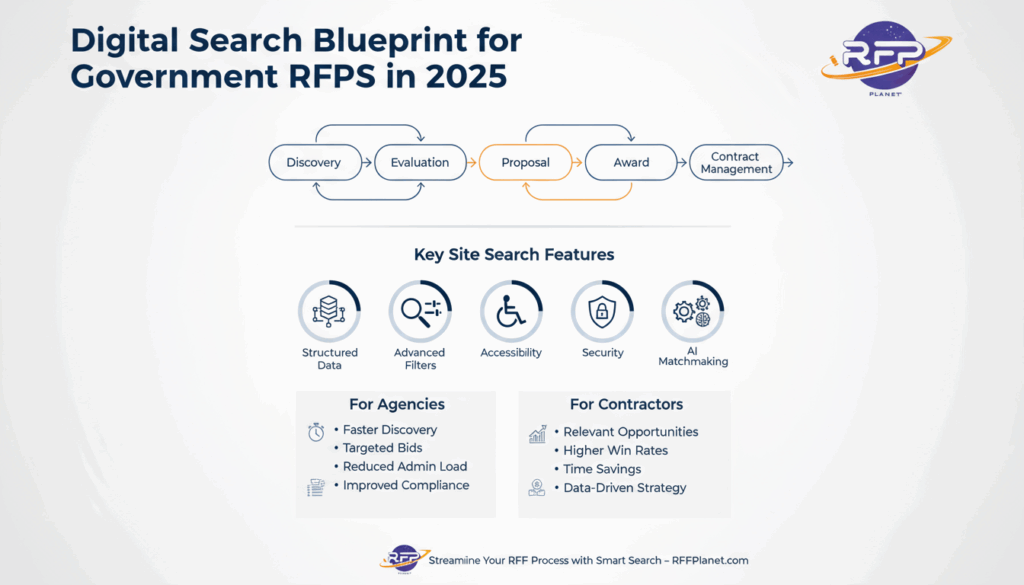
The process begins with RFP development, where project requirements are defined and the solicitation is drafted. Next comes the solicitation phase, in which the RFP is released publicly via procurement portals such as SAM.gov or GSA systems. Once proposals are received, the evaluation phase begins; agencies review submissions based on compliance, cost, and technical quality. After that, a contract award is made to the vendor offering the best value, and finally, post-award management ensures compliance and delivery of agreed-upon services, such as ongoing staffing and personnel services.
In today’s digital environment, every stage of this process must be searchable, trackable, and transparent across centralized databases to maintain accountability and accessibility for all participants.
Why Effective Site Search Matters in Modern Government RFPs
Modern procurement relies on discoverability. With hundreds of new solicitations issued daily, a precise, accessible search system ensures that both agencies and bidders benefit.
For Government Agencies
- Guarantees fair competition and compliance with federal procurement laws.
- Reduces redundant solicitations by exposing existing contracts.
- Enhances accountability through public access and version control.
For Contractors and Small Businesses
- Simplifies how bidders find relevant RFPs, RFQs, and RFIs.
- Enables quick filtering by industry code, agency, deadline, and location.
- Increases chances of success by connecting suppliers to the right opportunities early.
A well-structured site search bridges the gap between agency transparency and contractor visibility.
How Government Agencies Publish and Manage RFPs Online
Federal, state, and local governments rely on online procurement portals to issue RFPs and receive proposals. Portals like SAM.gov serve as the primary hub for federal procurement, while GSA eBuy and eLibrary catalog contracts and vendors. Many local governments have also built their own procurement websites for regional or municipal projects.
Every RFP posted on these platforms must be fully indexed and searchable. That means including critical metadata such as project title, reference number, contract type (fixed-price or cost-plus), NAICS code, agency name, submission deadlines, and keywords. Metadata tagging not only improves discoverability but also allows artificial intelligence systems to recommend related opportunities to users, creating a dynamic, data-driven procurement environment.
Core Site Search Requirements for Agencies in 2025
As digital procurement matures, site search requirements focus on usability, accessibility, and compliance:
Structured Metadata and Schema
Every RFP page should implement structured data (RFP schema markup) to help search engines categorize information. This falls under the broader umbrella of modern website design and development.
Advanced Filtering and Faceted Search
Contractors should be able to filter by category, agency, geography, status (open/closed), and contract value.
Accessibility Compliance (Section 508 / WCAG 2.2)
Government procurement sites must be fully accessible to users with disabilities. This includes alt text, screen-reader navigation, and clear PDF labelling.
Security and Transparency
Sites should use SSL encryption and maintain public archives. Robust network security and support services are critical to protecting sensitive bid information.
AI-Driven Search and Recommendation Engines
By 2025, AI algorithms are increasingly used to suggest relevant RFPs based on user profiles, reducing manual effort for both agency staff and bidders.
Building a Database for Government RFPs
A centralized RFP database underpins every procurement portal. It stores structured data about RFPs, RFQs (Requests for Quotation), and RFIs (Requests for Information).
Key database requirements:
- Unified Indexing: All open and archived solicitations should reside in a single searchable database. This often requires expert scanning and data entry services to digitize legacy documents.
- APIs and Inter-Portal Integration: Connect federal, state, and local portals to enable nationwide search.
- Bid Notification and Subcontract Management: Systems should alert users to new bid opportunities or changes in status.
- Performance Tracking: Include contract award data and past performance metrics for transparency.
For contractors, this means fewer missed opportunities and more time to prepare proposals.
Optimizing RFP Visibility for Contractors
For contractors, the RFP search portal functions as a digital marketplace where visibility equals opportunity. The key is knowing how to navigate it strategically. Using specific keywords such as exact NAICS codes helps narrow results, a task often supported by market research and classification study firms. Setting automated alerts ensures that contractors receive timely notifications of new RFPs matching their business profile, while filtering results by submission deadlines allows them to focus on active solicitations.
Monitoring RFP status changes provides additional insight. By tracking which contracts were awarded or cancelled, contractors can study competitors and refine their bidding approach. Reviewing past performance data from prior winners offers further guidance on pricing and proposal structure.
Small businesses, in particular, can gain an edge through AI-powered tools that scan procurement sites, flag eligible opportunities, and even generate initial response drafts for internal review.
This combination of automation and human expertise dramatically improves efficiency and competitiveness.
Crafting a Compliant and Search-Friendly RFP Document
A well-structured RFP document is essential for searchability and compliance. According to AcqNotes and FAR guidelines, a government RFP typically includes thirteen sections (A to M). To improve keyword discoverability, agencies should provide plain-language summaries, a task that may require professional writing services.
- Section A: Solicitation Form
- Section B: Supplies and Services with Pricing Information
- Section C: Description / Statement of Work
- Section D – J: Administrative and Contract Clauses
- Section K – M: Certifications, Instructions, and Evaluation Criteria
To make these documents search-friendly:
- Use consistent file naming and metadata tags.
- Publish machine-readable PDFs rather than scanned images.
- Include a “compliance matrix” so bidders can quickly align responses with requirements.
- Provide plain-language summaries to improve keyword discoverability.
Best Practices for Responding to Government RFPs Online
Responding to a government RFP is a process that demands precision and discipline. Contractors must read and follow every instruction carefully; even a small deviation from required formatting can result in automatic disqualification. A strong technical proposal should explain exactly how the bidder’s solution meets or exceeds the project’s stated objectives, supported by detailed data and methodology.
Equally important is providing evidence of past performance. Government agencies rely heavily on historical results, and strong financial standing demonstrated through auditing and accounting services builds trust. Contractors should also submit transparent cost proposals that justify pricing assumptions. In addition, risk management strategies and compliance assurances, often developed with legal and attorney services, show evaluators that the bidder understands government procurement policies.
According to industry analyses, the most common errors in bid responses include missing attachments, incomplete forms, and failure to address evaluation criteria.Preventing these mistakes begins with disciplined internal review and quality assurance before submission.
AI and Automation in the RFP Process (2025 Update)
Artificial Intelligence is reshaping government procurement on both sides of the table:
For Agencies
- AI search models analyze past proposals and recommend qualified contractors.
- Machine learning identifies duplicate or redundant RFPs to streamline processes.
- Predictive algorithms forecast bid volume and contract completion rates.
For Contractors
- NLP-powered tools scan new RFP documents to highlight mandatory requirements.
- Automated response systems generate initial drafts for proposal teams.
- AI analytics compare historical win rates and suggest proposal improvements.
By 2025, AI and automation are not luxuries but essentials for speed and competitive advantage, with a growing market for specialized AI software and development services.
Common Mistakes and How to Avoid Them
Both agencies and contractors often encounter avoidable pitfalls:
| Perspective | Common Mistake | Impact |
|---|---|---|
| Agency | Unsearchable RFP PDFs or missing metadata | Contractors can’t locate active bids easily |
| Agency | No filters for small business or NAICS code | Limits SME participation |
| Contractor | Ignoring submission instructions | Automatic disqualification |
| Contractor | Generic proposals not customized to agency | Lower evaluation scores |
| Both | Missed deadlines or late uploads | Immediate exclusion |
Frequently Asked Questions
How do I find open government RFPs in 2025?
You can locate current opportunities through federal and state procurement portals such as SAM.gov, GSA eBuy, or local government websites. Setting up automated bid notifications and using filters based on keywords or NAICS codes will help you identify the most relevant solicitations quickly.
What search filters should a government RFP portal include?
An effective procurement portal should allow filtering by agency, industry code, contract type, location, budget range, and closing date. Adding options like “small business set-aside” and “minority-owned vendor” further enhances fair competition.
How can small businesses compete effectively through online portals?
Small businesses should register with SAM.gov, complete detailed capability profiles, and focus on set-aside contracts designed for their category. Responding to each RFP with accurate data, measurable past performance, and clear pricing transparency can substantially improve win rates.
Conclusion: Building a Transparent, Accessible, and Search-Ready RFP Ecosystem
The future of government procurement is digital, data-driven, and deeply search-centric. When agencies build searchable, accessible RFP databases and contractors adopt AI-powered tools to find and respond to opportunities more efficiently, everyone benefits. Together, they create a procurement ecosystem that prioritizes transparency, speed, and measurable value for taxpayers.
Whether your business specializes in IT, construction, or professional consulting, RFP Planet provides the tools to find and win government contracts. If you are ready to navigate the procurement landscape more effectively, reach out to our expert team to discover how we can help.
A search-ready RFP infrastructure is no longer a technical luxury. It is the foundation of public trust and procurement efficiency.