The RFP process, short for Request for Proposal, is one of the most critical yet often misunderstood parts of modern procurement. When done strategically, it ensures fair competition, objective vendor evaluation, and better long-term results for your organization. When rushed or poorly managed, it leads to wasted time, confusion, and costly misalignments.
In this guide, we will simplify every stage of the RFP process into actionable insights and proven best practices. Whether you are a financial professional, procurement manager, or business decision-maker, you will learn how to create a clear, repeatable framework that transforms how you source vendors, evaluate proposals, and manage results.
Understanding the RFP Process
A Request for Proposal (RFP) is a structured document and workflow designed to collect detailed proposals from potential vendors. Its purpose is simple: to help organizations make informed purchasing decisions through transparent and standardized evaluation.
Unlike informal quotes or quick negotiations, RFPs provide a data-based foundation for vendor selection, especially for projects with significant financial or operational impact, such as engaging professional consulting, administrative, and management services. This process ensures accountability, fairness, and consistency while mitigating risks.
Key Benefits of a Well-Run RFP Process
- Enables objective vendor comparison through standardized evaluation criteria
- Encourages competitive pricing and innovation
- Improves transparency across stakeholders
- Reduces project delays and procurement risk
- Creates a repeatable framework for future sourcing
Why Streamlining Your RFP Process Matters
A traditional RFP can take anywhere from four to eight weeks to complete. Most delays arise from unclear requirements, scattered feedback, or manual coordination, not from the vendors themselves. Streamlining your RFP process with automation, collaboration tools, and clear templates can reduce this timeline dramatically while improving accuracy and vendor engagement.
A streamlined process:
- Keeps internal teams aligned from start to finish
- Attracts higher-quality vendor proposals
- Builds credibility with external partners
- Enhances compliance and audit readiness
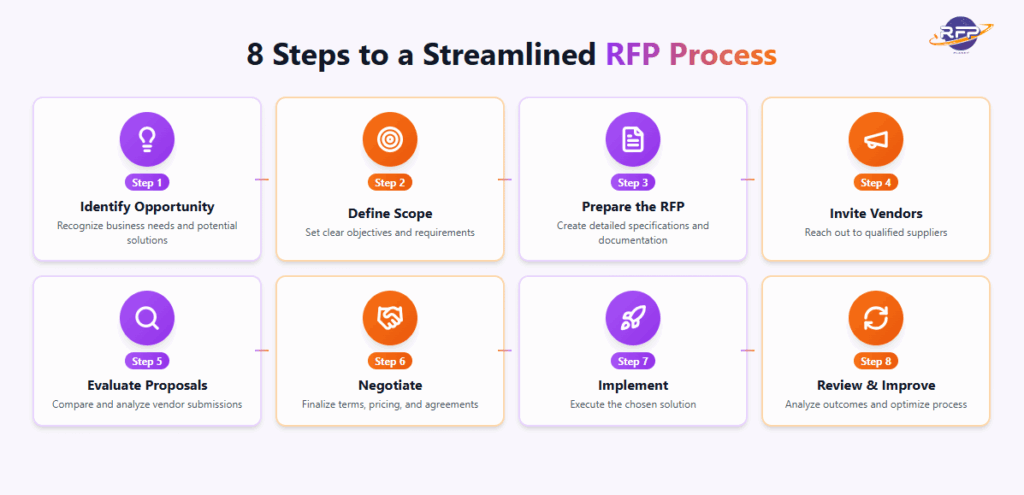
Step 1: Identify the Right Opportunity
Start with a spend analysis or needs assessment. Review current supplier relationships, budgets, and service gaps. Determine whether issuing an RFP is truly necessary, sometimes a Request for Information (RFI) or Request for Quotation (RFQ) may suffice for smaller purchases.
Use an RFP when:
- The project is strategic, high-value, or complex
- You need customized solutions or innovation from vendors
- Multiple vendors can potentially meet the need
- Objective scoring and documentation are required for compliance
Pro Tip: Talk to internal stakeholders early. Their operational insights ensure that your RFP reflects real-world requirements rather than assumptions.
Step 2: Define Scope and Objectives Clearly
Clarity is the foundation of any effective RFP. Define your project goals, scope of work, deliverables, and evaluation criteria before you start writing the document.
Include in your scope definition:
- Project objectives and measurable outcomes
- Deliverables with clear timelines and milestones
- Technical and functional requirements
- Budget range or constraints
- Evaluation and scoring methodology
A kickoff meeting with key stakeholders (finance, operations, compliance, and technical experts) ensures everyone agrees on goals, criteria, and decision timelines.
Step 3: Develop the RFP Document
Your RFP should read like a professional, easy-to-navigate blueprint not a legal maze. Keep it concise but detailed enough to allow vendors to craft accurate responses.
Essential Components of an RFP Document:
- Introduction and Background: Explain your organization’s mission and what you aim to achieve.
- Scope of Work: Outline the project details, deliverables, and performance metrics.
- Timeline and Deadlines: Include key milestones like question submission, proposal due date, and evaluation schedule.
- Evaluation Criteria: Specify how proposals will be scored (e.g., 40% technical quality, 30% price, 20% experience, 10% innovation).
- Submission Instructions: Define the required format, document naming conventions, and contact points.
- Legal and Compliance: Add confidentiality terms, data security standards, and NDA requirements, often drafted with support from legal and attorney services.
Tip: Use an RFP template or proposal checklist to maintain consistency across projects while saving time for future issuances.
Step 4: Invite Vendors and Manage the Bid Window
After finalizing your RFP, identify a short list of qualified vendors typically five to seven candidates. Invite them to participate, ensuring a balance between competition and manageability.
During the open bid window:
- Encourage vendors to ask clarifying questions
- Share all answers publicly to maintain fairness
- Keep communication centralized, avoid one-on-one discussions
- Use digital tools or RFP management software for efficiency
Allow sufficient time (usually two to three weeks) for vendors to prepare quality responses. Tight deadlines can discourage qualified bidders and lead to incomplete submissions.
Step 5: Receive and Evaluate Proposals
When proposals start arriving, review them for completeness before scoring. Eliminate submissions that fail to meet basic requirements but be transparent about disqualification reasons.
Establish a scoring system:
- Define weights for each category (e.g., price, experience, technical fit)
- Use RFP weighted scoring to prioritize what matters most
- Include multiple reviewers to reduce bias
- Record all scores and notes for auditability
Evaluation should be both quantitative (price, compliance) and qualitative (innovation, cultural fit). Consider involving technical and operational stakeholders for section-specific scoring.
Step 6: Shortlist and Conduct Clarifications
Once initial scoring is complete, shortlist the top three to five vendors. Host clarification sessions or product demos to resolve open questions. This phase may include:
- Live presentations or proofs of concept, especially for projects like website design and development
- Financial audits or security reviews
- Discussions around customization and implementation support
If necessary, request a Best and Final Offer (BAFO) from finalists to refine pricing and terms.
Step 7: Negotiate and Award the Contract
Move into structured negotiations with your preferred vendor. Address any outstanding issues from earlier phases and finalize terms such as:
- Service level agreements (SLAs)
- Deliverable timelines
- Payment terms
- Warranty or support commitments
Consider using e-signatures and electronic procurement tools to expedite approvals and maintain an audit trail. Once both parties sign, communicate the award internally before informing all participants.
Step 8: Implementation and Transition
A successful RFP does not end with the award, it transitions into implementation. Ensure smooth onboarding by:
- Communicating expectations to internal stakeholders and the vendor
- Defining points of contact for project management
- Setting up performance monitoring dashboards
Document key metrics such as cost savings, delivery time, and satisfaction scores to measure vendor success over time.
Step 9: Debrief and Continuous Improvement
After project completion, conduct a post-RFP review with both your internal team and participating vendors. Ask:
- What worked well in the process?
- Which steps caused delays or confusion?
- How did vendors perceive the clarity of requirements?
Providing constructive feedback to unsuccessful vendors enhances your reputation and encourages stronger future participation.
Continuous refinement of templates, scoring systems, and communication methods is what turns a standard procurement process into a best-in-class one.
Best Practices for an Effective RFP Process
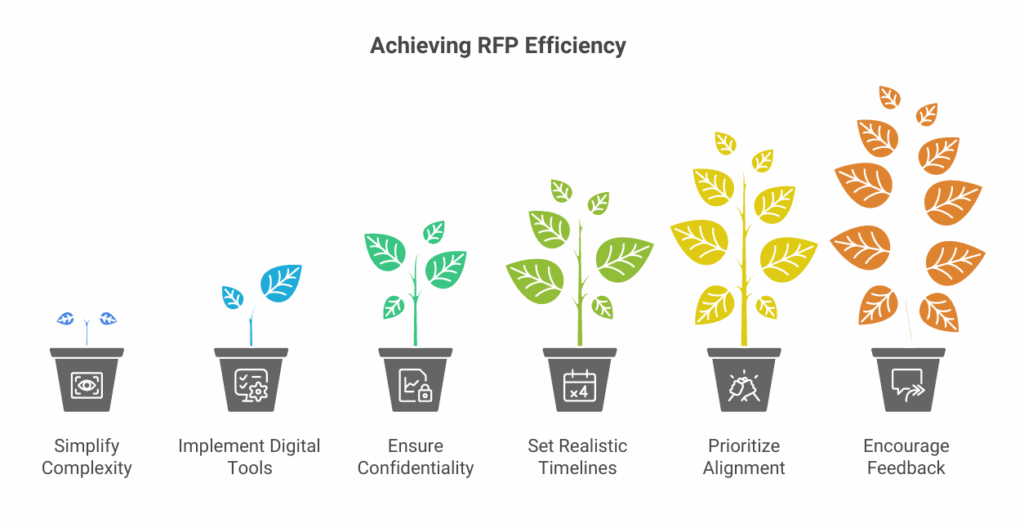
- Limit unnecessary complexity. Use plain language and clear formatting.
- Use digital RFP tools to track submissions, automate scoring, and maintain version control.
- Maintain confidentiality among evaluation teams.
- Set realistic timelines. Most RFPs can be completed efficiently in four weeks with proper planning.
- Prioritize alignment over speed. Clarity at the start prevents rework later.
- Encourage feedback loops with both vendors and stakeholders.
By integrating these best practices, organizations can dramatically reduce cycle times and improve the quality of their outcomes.
The Role of Stakeholders in the RFP Process
Every RFP involves collaboration between different groups:
- Project Manager: Leads the process, defines evaluation methodology, and ensures compliance.
- Procurement Officer: Manages communication and official issuance.
- Evaluation Committee: Scores proposals based on weighted criteria.
- Executives or CFOs: Approve final selection and contract terms, often relying on detailed reports from auditing, finance, and accounting services.
- Vendors: Submit proposals and clarify technical details.
Strong coordination among these roles prevents delays, ensures fairness, and keeps the evaluation unbiased.
Common RFP Challenges and How to Overcome Them
| Challenge | Solution |
|---|---|
| Unclear Requirements | Host a pre-RFP alignment meeting and document scope carefully. |
| Vendor Drop-outs | Provide transparent timelines and respond to queries promptly. |
| Inconsistent Scoring | Use standardized evaluation sheets and weighted scoring systems. |
| Timeline Slippage | Set internal deadlines with buffer time and assign responsibilities early. |
| Too Many Proposals | Pre-qualify vendors to ensure only relevant submissions. |
Leveraging RFP Automation Tools
Modern RFP software platforms simplify the entire workflow from drafting templates to evaluating responses. They centralize communication, automate reminders, and provide analytics on vendor performance. Features may include:
- Dynamic templates and questionnaires
- Automated scoring and comparison
- Collaboration dashboards
- Secure document sharing
Using such tools reduces manual errors and enables faster, data-driven decisions.
RFP vs. RFI vs. RFQ: Understanding the Difference
| Request Type | Purpose | When to Use |
|---|---|---|
| RFI (Request for Information) | To gather general market insight | Early research stage |
| RFP (Request for Proposal) | To solicit detailed solutions | When project scope and needs are defined |
| RFQ (Request for Quotation) | To compare pricing for specific products/services | When requirements are standardized |
This distinction helps organizations avoid over-engineering simple purchases while ensuring complex decisions follow a structured RFP route.
FAQ’s on RFP
What is the purpose of an RFP process?
The RFP process helps organizations collect structured vendor proposals to make fair, data-driven decisions. It ensures transparency, cost control, and alignment between internal goals and vendor capabilities.
How long does a typical RFP process take?
Most RFP cycles take 4–8 weeks, depending on project complexity and the number of vendors involved. With digital tools and clear templates, it can often be completed in under a month.
What should be included in a good RFP document?
A strong RFP includes your organization’s background, project scope, deliverables, evaluation criteria, pricing format, submission instructions, and timelines. Clear requirements help vendors craft precise, comparable proposals.
How can I evaluate RFP responses effectively?
Use weighted scoring criteria (e.g., cost, experience, technical quality, innovation). Involve multiple reviewers, automate scoring when possible, and maintain transparency throughout evaluation.
What’s the difference between RFI, RFP, and RFQ?
RFI (Request for Information): Gather preliminary market insights.
RFP (Request for Proposal): Solicits detailed solutions from qualified vendors.
RFQ (Request for Quotation): Focuses mainly on pricing for standardized services.1
How can automation improve the RFP process?
Automation tools streamline communication, track deadlines, and centralize evaluation data. They reduce manual errors, speed up scoring, and provide clear audit trails for compliance and reporting.
7. Why do RFPs fail or underperform?
Common causes include unclear requirements, unrealistic deadlines, or poor stakeholder alignment. Avoid these by defining goals early, using templates, and conducting post-RFP reviews.
How do you ensure fairness in vendor selection?
Maintain consistent scoring rules, share the same clarifications with all vendors, and involve a diverse evaluation committee. Transparency builds trust and ensures objective outcomes.
Final Thoughts: Building an RFP Process That Drives Better Results
A streamlined RFP process is not just about faster timelines; it is about better outcomes. When you define clear goals, use structured templates, and foster transparent communication, your procurement becomes a strategic advantage, not an administrative burden.
The most successful organizations view each RFP not as a transaction, but as an opportunity to build lasting partnerships, strengthen governance, and unlock new efficiencies. At RFPPlanet, we specialize in helping organizations of all sizes optimize their procurement workflows with expert guidance and powerful tools.
If you are ready to transform your approach, get in touch with our procurement specialists to discuss your needs.