
The legal industry is evolving faster than ever. Whether you are part of a corporate legal department or a private practice, the Request for Proposal (RFP) process has become central to how law firms win or lose business. With procurement teams playing a bigger role and clients demanding more transparency, law firms can no longer treat RFPs as routine paperwork.
This guide is your roadmap to understanding the latest law firm RFP trends, mastering the legal procurement process, and applying proven strategies that help you stand out even in a crowded field of competitors.
What Is a Law Firm RFP and Why Does It Matter?
A law firm RFP (Request for Proposal) is a structured invitation for law firms to propose how they’ll deliver legal services, along with pricing and strategic value. Corporate legal departments use RFPs to identify the most capable partners while ensuring transparency, compliance, and cost efficiency.
For firms, the stakes are high. Winning the right RFP not only strengthens your client portfolio but also increases your firm’s market visibility and long-term profitability. Many law firms now view RFPs as strategic growth channels and opportunities to prove their capability and win trust through data-driven, value-based proposals.
Key Trends Shaping the Law Firm RFP Landscape
Increase in Legal Service RFPs
Law firms are now responding to more RFPs than ever before. This is not just about competition but it reflects a shift in how clients allocate legal work. Corporations are prioritizing cost efficiency, measurable outcomes, and reduced dependency on legacy relationships.
The rise in legal service RFPs is also fueled by an emphasis on performance tracking and accountability. For law firms, this trend means more opportunities but also tighter scrutiny. Firms that take time to understand client pain points and align proposals with business goals are more likely to win and retain work.
The Rise of Legal Procurement Teams
Gone are the days when only general counsel decided which firm gets the mandate. Today, procurement professionals often co-lead the law firm selection process, using detailed scorecards and performance metrics.
Procurement brings structure to what was once an intuitive process, balancing legal expertise with business value. As a result, firms must communicate in dual languages: one that speaks to legal excellence, and another that demonstrates operational efficiency, predictable pricing, and measurable impact.
Technology Is Reshaping the RFP Process
The digital transformation of the legal industry has reached RFP management. Automation, AI, and specialized RFP software are making it faster and easier for firms to respond to proposals accurately and efficiently.
From centralized content libraries to AI-assisted answer suggestions, these tools reduce manual labor and standardize quality, allowing law firms to focus on strategy, not just formatting. The result? Faster turnaround times, data-backed decision-making, and higher win rates.
Reverse Auctions in Legal Procurement
A standout trend in 2025 is the growing adoption of reverse auctions in legal sourcing. In a reverse auction, shortlisted law firms bid competitively in real-time, often lowering their rates to win work.
While this approach may feel intimidating, it promotes transparency and gives every participant a fair shot. Law firms that prepare structured pricing models and understand their minimum profitable thresholds can thrive in such competitive environments.
Example workflow:
- The client issues an RFP and shortlists qualified firms.
- Shortlisted firms submit bids.
- The system displays real-time pricing (without revealing firm names).
- Firms can adjust bids within a timed window.
- The client selects the optimal combination of price and quality.
Demand for Transparency and Diversity
Clients no longer just want cost-effective legal advice, they also want partners who reflect their values. Diversity, ESG reporting, and community engagement are becoming part of every major RFP’s evaluation criteria.
Firms that clearly outline their diversity policies, sustainability commitments, and pro bono work often gain a competitive advantage. Demonstrating shared purpose is now just as important as demonstrating legal expertise.
The Law Firm RFP Process Explained
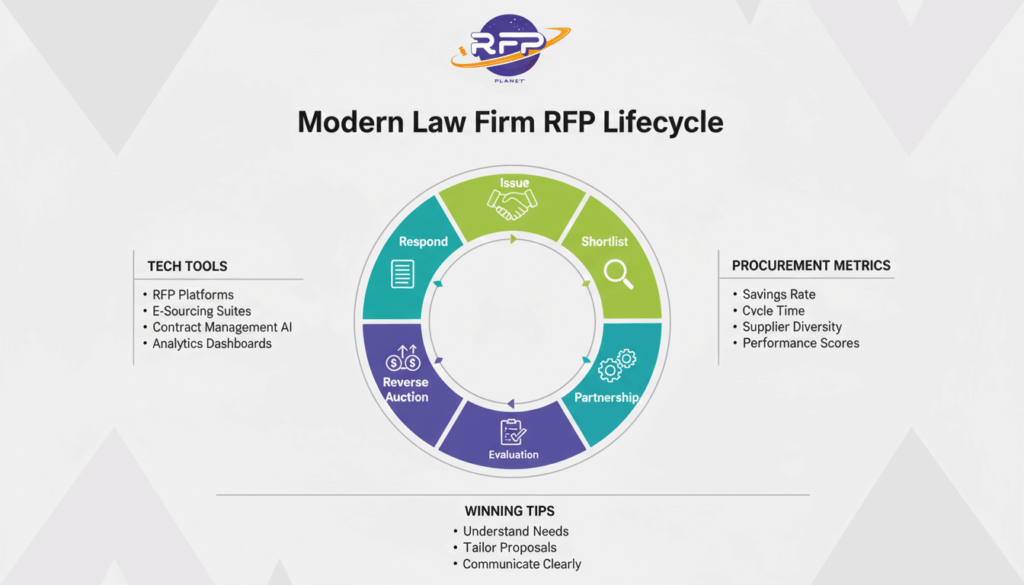
The RFP process for legal services typically unfolds in four structured stages:
- Issuance: The client identifies needs and invites proposals.
- Evaluation: Submissions are assessed based on pricing, expertise, and cultural alignment.
- Selection: Shortlisted firms are interviewed or invited to refine their offers.
- Onboarding: The chosen firm signs the agreement and joins the client’s legal panel.
Successful firms treat each RFP as both a sales process and a learning opportunity, refining their proposals after every round.
Common Legal RFP Requirements
Modern legal RFPs go beyond hourly rates. They often include:
- Case studies demonstrating relevant experience.
- Proposed alternative fee arrangements (AFAs) such as fixed, capped, or blended fees.
- Diversity and ESG reporting.
- Value added services like training, risk workshops, or compliance tools.
Firms that proactively address these areas, instead of waiting to be asked, often score higher in evaluations.
Tips to Win More Law Firm RFPs
Customize Every Proposal
Generic responses are easy to spot and easy to dismiss. Personalize every proposal by referencing the client’s business model, pain points, and objectives. Use relevant data, success stories, and measurable outcomes to make your case.
Automation tools can help manage content, but personalization must remain at the heart of every submission.
Engage Early and Ask Smart Questions
Do not hesitate to ask clarifying questions during the RFP phase. This not only helps tailor your proposal but also shows genuine interest. Engage with the client to understand why they issued the RFP, what their expectations are, and what value they prioritize most.
Early engagement demonstrates your consultative mindset positioning you as a trusted advisor, not just a vendor.
Leverage Legal Procurement Knowledge
Understanding how procurement teams think can significantly improve your win rate. Procurement focuses on reliability, predictability, and long term efficiency. They prefer partners who can quantify value, not just promise it.
Include metrics like turnaround times, client satisfaction scores, and performance KPIs. Data backed storytelling turns a standard proposal into a compelling business case.
Create a Repeatable RFP Process
Efficiency and consistency matter. Establish a repeatable, well-documented RFP response process within your firm. Define roles, maintain a centralized content library, and continuously refine based on feedback.
A structured internal workflow can reduce proposal creation time by up to 40%, freeing up your team to focus on quality and strategy.
Include a Thoughtful Cover Letter
Your RFP cover letter is your first impression and often your last chance to connect emotionally. Use it to summarize the proposal’s intent, highlight your firm’s understanding of the client’s challenges, and express enthusiasm for collaboration.
A well-crafted, human cover letter adds warmth to an otherwise technical process.
How Procurement Technology Is Changing the Legal Marketplace
The Data-Driven Future
The integration of technology in legal procurement has turned the RFP process into a measurable science. Procurement professionals now use dashboards to track firm performance, evaluate diversity metrics, and monitor billing efficiency.
For law firms, adopting client-facing tools such as project dashboards, performance reports, or client portals demonstrates transparency and builds credibility.
The Rise of Reverse Auctions in Legal Services
Reverse auctions are redefining the balance between value and price. Instead of seeing them as a race to the bottom, forward-thinking law firms treat them as strategic pricing exercises.
By analyzing competitor behavior, firms can refine their internal cost structures and identify areas to optimize operations leading to long-term efficiency gains beyond any single bid.
The Role of Diversity, ESG, and Value-Added Services
Clients are now choosing partners who align with their mission, not just their budgets. Including a section on diversity, inclusion, environmental sustainability, and community engagement can make your RFP response more compelling.
Offer examples of value-added initiatives like:
- Free CLE (Continuing Legal Education) sessions.
- Legal risk updates or compliance briefings.
- Community-based legal aid contributions.
These details not only strengthen your brand image but also demonstrate your commitment to partnership beyond transactions.
Common Mistakes Law Firms Make in RFPs
Even experienced firms stumble in the RFP process. The most frequent mistakes include:
- Submitting recycled content with minimal customization.
- Overlooking procurement scoring methods.
- Failing to show measurable results or ROI.
- Underestimating pricing strategy and negotiation readiness.
- Ignoring post-submission follow-ups or feedback.
Learning from each RFP, win or lose, helps build a knowledge base for future success.
The Future of Legal Procurement and RFPs
As the legal services marketplace continues to evolve, technology and analytics will play an even greater role. Expect to see:
- AI-driven evaluation tools simplifying client selection.
- Predictive analytics forecasting performance outcomes.
- Closer collaboration between firms and clients using integrated platforms.
The next wave of success will belong to firms that blend expertise, innovation, and empathy in every proposal they send.
Final Tips for Law Firms: How to Win and Retain Clients
Success in RFPs does not end when you win, it begins there.
Keep refining your approach by:
- Building lasting client relationships beyond projects.
- Maintaining a living library of proposal templates.
- Using analytics to evaluate response effectiveness.
- Encouraging feedback loops within your team.
RFPs are no longer transactional but they are relationship accelerators. Treat each one as a gateway to sustainable growth.
FAQ’s on Law Firm RFP
What is an RFP in the legal industry?
An RFP, or Request for Proposal, is a formal document that organizations use to invite law firms to propose their services for specific legal needs. It outlines project details, requirements, and evaluation criteria used to select the most qualified firm.
Why are RFPs important for law firms today?
RFPs have become a key driver of growth and competition. They allow law firms to showcase their value, differentiate their expertise, and secure partnerships with corporations and government entities through transparent and data driven selection processes.
What are the latest trends in law firm RFPs?
Current law firm RFP trends include the rise of procurement led evaluations, the use of RFP automation software, adoption of reverse auctions, and increased emphasis on diversity, ESG reporting, and pricing transparency.
How can law firms win more RFPs?
Winning law firm RFPs requires customization, clear communication, and understanding of legal procurement expectations. Law firms should tailor proposals to client goals, demonstrate measurable ROI, and leverage technology for efficiency and consistency.
What role does technology play in the law firm RFP process?
Modern RFP software automates proposal management, reduces manual work, and improves accuracy. Firms using AI-powered RFP tools and analytics dashboards experience faster turnaround times and higher win rates.
What is a reverse auction in legal procurement?
A reverse auction is a competitive, real time bidding process where shortlisted law firms lower their prices against competitors to secure work. It promotes cost transparency and value-based pricing while encouraging firms to refine their efficiency.
How is procurement changing law firm selection?
Procurement professionals now co-lead the RFP process with general counsel, using performance data and software scoring systems. They prioritize efficiency, innovation, and accountability, reshaping how law firms approach client relationships.
Summary: Key Takeaways
The law firm RFP process is now a key driver of growth and client trust. As legal procurement becomes more data-driven, firms that align their proposals with client goals and demonstrate measurable value stand out. Technology and automation are reshaping how RFPs are managed, helping law firms respond faster, more accurately, and with greater strategic focus. To learn how RFP Planet’s aggregation services can help your team find qualified leads, contact us today for a consultation.
Ultimately, winning an RFP is not about offering the lowest price, it is about proving expertise, transparency, and partnership potential. Firms that embrace innovation, diversity, and consistent improvement are best positioned to succeed in the evolving world of legal procurement.