If you are a financial or business professional tasked with issuing or responding to a Request for Proposal (RFP), understanding the core dos and don’ts can save time, prevent costly mistakes, and lead to better partnerships. This comprehensive guide outlines the proven best practices, mistakes to avoid, and expert strategies to master the RFP process from preparation to evaluation and vendor selection.
What Is an RFP and Why It Matters
An RFP (Request for Proposal) is a document organizations use to solicit bids from vendors for a specific service, product, or solution. A well-crafted RFP sets clear expectations, aligns stakeholders, and ensures a transparent, objective evaluation process.
For example, an RFP is used to solicit bids for specific services, whether for digital marketing services or specialized consulting, administrative, or management services.
For vendors, responding to an RFP means presenting a proposal that demonstrates value, understanding of the scope of work, and capability to deliver within the timeline and budget.
In short, a good RFP bridges the gap between business needs and vendor capabilities, ensuring that both parties align toward shared success.
How to Prepare for an RFP – The Foundation of a Successful Process
Before you create or send the RFP, preparation is key. A successful RFP starts with clarity and collaboration.
Do: Understand the Scope and Objective
Define what success looks like. Clarify project goals, key deliverables, and constraints. Ensure all stakeholders from finance to operations, agree on priorities before drafting the document.
Don’t: Rush into Drafting
Rushing leads to missing specific needs and ambiguity in requirements. Allocate enough time for research, internal discussions, and stakeholder input. A thoughtful start sets the tone for a professional RFP process.
Key Elements Every Good RFP Should Include
Every effective RFP follows a structure that communicates both clarity and purpose.
A good RFP includes:
- A background summary explaining your business and objectives
- A scope of work section defining deliverables
- Clear evaluation criteria and scoring methods
- Submission details (deadlines, contact info, and formatting)
- Optional: An RFP template for consistency
Avoid jargon or internal abbreviations. Keep language concise and user-friendly, so vendors understand your expectations clearly.
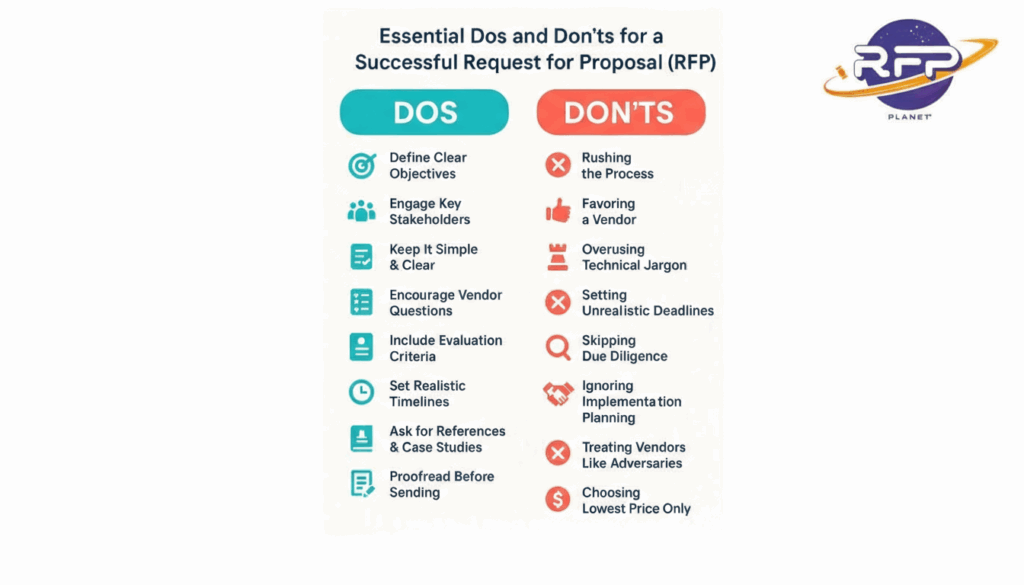
The Dos of Writing a Strong RFP
1. Do Collaborate With Stakeholders
Engage your key stakeholders early. Their insights help refine requirements and prevent internal conflicts later. Collaborative input ensures the RFP reflects true business priorities.
2. Do Provide a Realistic Timeline
Include a transparent timeline with milestones for submission, evaluation, and decision-making. This helps vendors align their responses and prepare accurate proposals.
3. Do Include Scoring and Evaluation Metrics
Explain how proposals will be evaluated like cost, experience, references, or innovation. A transparent evaluation process enhances fairness and encourages high-quality submissions.
4. Do Encourage Vendor Questions
Allow vendors to clarify doubts. Open communication leads to better quality proposals and prevents misinterpretations that could derail the project later.
5. Do Request References and Case Studies
Always ask for real-world case studies or references. These demonstrate a vendor’s track record and ability to deliver on similar types of projects.
The Don’ts – Avoid These Common RFP Mistakes
1. Don’t Treat Vendors as Adversaries
Your vendor is not your opponent. The RFP is a two-way street, designed for collaboration. Treat vendors as potential partners, not bidders in a zero-sum game.
2. Don’t Overcomplicate Requirements
Keep it simple. Too many conditions or complex submission rules may discourage qualified vendors to respond. Focus only on what is essential to the project.
3. Don’t Set Unrealistic Deadlines
Short deadlines often result in rushed, low-quality proposals. Allow adequate time for thoughtful responses that reflect your needs accurately.
4. Don’t Show Bias
Avoid giving one preferred vendor insider information. Maintain transparency and equal opportunity for all participants.
5. Don’t Skip Due Diligence
Before sending an RFP, research your vendors. Check their credentials, financial stability, and compliance record. Neglecting due diligence can lead to costly mistakes.
How to Evaluate RFP Responses Effectively
Once submissions arrive, the evaluation phase begins. Create a scorecard that aligns with your rfp requirements and objective.
Step 1: Verify compliance and ensure each proposal meets baseline requirements.
Step 2: Evaluate based on your scoring rubric (technical ability, pricing, support).
Step 3: Conduct vendor demos or interviews to clarify ambiguous details.
Step 4: Document all decision-making discussions for transparency.
The goal is to evaluate proposals objectively while keeping future partnership potential in mind.
Pricing, Budget, and Value Considerations
Pricing is crucial but it is not everything.
A successful RFP balances pricing with value and long-term benefits. Choose vendors who align with your goals rather than simply offering the lowest bid.
Do: Opt for value-based pricing where cost reflects expertise, support, and scalability.
Don’t: Let price alone dictate your decision but it often leads to poor implementation and higher hidden costs later.
Customizing the RFP for Specific Needs
A generic RFP rarely leads to optimal results. Customize your RFP to fit the project’s specific needs.
Use an RFP template as a starting point but tailor each section to the scope of work and your industry. Provide contextual information such as unique challenges or constraints.
Customization helps vendors align their solutions more closely with your business development goals.
Avoiding Jargon and Improving Clarity
Don’t: Overload your RFP with technical jargon or industry acronyms that limit comprehension.
Do: Use clear, concise language that’s easy for both internal reviewers and external vendors to understand.
This clarity improves the evaluation process and ensures that your document reflects professionalism and accessibility.
How to Ensure a Smooth Decision-Making Process
A defined decision-making process prevents confusion and delays.
- Involve all key stakeholders in scoring and deliberations.
- Communicate decisions respectfully to vendors who were not selected.
- Document rationale for transparency and future opportunities.
Remember: A well-handled decision process leaves the door open for future partnerships even with vendors you did not choose.
Common Mistakes That Undermine the RFP Process
- Failing to understand your business goals before drafting
- Neglecting to compare offerings objectively
- Ignoring the timeline or missing communication checkpoints
- Expecting vendors to read your mind instead of asking for clarity
- Forgetting that RFPs are a relationship with the client, not just paperwork
This includes managing complex tasks like maintaining secure records and document management services. Avoiding these common mistakes ensures smoother execution and better outcomes.
The Dos and Don’ts of the RFP Response Process
For vendors responding to an RFP:
- Do: Research the buyer thoroughly before responding.
- Do: Customize your proposal, showing you understand the scope.
- Don’t: Submit a copied proposal; personalize every response.
- Don’t: Use excessive technical jargon, focus on the client’s perspective.
- Do: Highlight your use cases, references, and quality proposals that prove credibility.
FAQs About RFP Best Practices
What is the most common mistake when writing an RFP?
The biggest mistake is rushing through preparation without gathering input from all stakeholders. This often leads to incomplete requirements and poor vendor responses.
How can I make my RFP stand out to vendors?
Provide clear instructions, realistic timelines, and transparent evaluation criteria. Vendors value clarity and fairness and it helps to encourage stronger, more creative proposals.
How do I evaluate RFP responses fairly?
Use a pre-defined scoring system that prioritizes value, quality, and capability. Avoid bias by including multiple reviewers in the evaluation process.
Should price be the deciding factor in RFP evaluation?
No. While pricing matters, focus on total value, experience, quality, and alignment with your goals are often more important than being the lowest bid.
What makes an RFP response successful?
A winning response is customized, concise, and aligned with your objectives. It demonstrates understanding of your specific needs and offers tailored solutions backed by data or case studies.
Final Thoughts – Building Successful Partnerships Through Better RFPs
Creating or responding to an RFP is not just about transactions but it is about building successful partnerships. Whether you are drafting the document or submitting a proposal, focus on clarity, fairness, and long-term value.
When properly executed, the RFP process becomes a strategic advantage that helps organizations to find the right partner and vendors secure high-value contracts.
RFP Planet lists thousands of bids across categories like Architectural, IT, Finance, and other professional services. Reach out to our RFP experts today.